Empowering the Future: Mō Āpōpō Future-Makers

As part of the Next Generation Foresight Practitioners (NGFP) community, Fellows are applying futures and foresight approaches in diverse contexts around the world. In this story, NGFP 2023 Fellow Alice Dimond reflects on Mō Āpōpō Future-Makers, an initiative led by Tokona te Raki in Aotearoa New Zealand that empowers rangatahi (young people) to imagine and shape the futures they want to inherit.
Hope may feel in short supply right now as we find ourselves facing increasingly frequent and complex challenges globally. But New Zealand-based Indigenous social innovation lab, Tokona te Raki, is creating spaces for young people to dream big, work together and design futures of their own making through its latest rangatahi initiative, Mō Āpōpō Future-Makers. Initiatives like Mō Āpōpō reflect a growing recognition of the importance of futures literacy and youth agency in shaping long-term societal outcomes.
Piloted in 2025 across high schools, with youth organisations and workshops, Mō Āpōpō brings young people together to think creatively about the future Aotearoa that they want to share in. In a world of blame games, finger pointing and decisions being levelled at us rather than reached with us, these young people are learning that change doesn’t have to be something that happens to them; they can assert agency in determining the future they inherit.
“Change doesn’t have to be something that happens to young people; they can assert agency in determining the future they inherit.”
The project is driven by research commissioned in 2025 by Tokona te Raki, the Aotearoa Futures Barometer, which found that over fifty percent of young people are increasingly concerned about how their needs are met, and sixty-three percent of young women are worried about the future. The research inferred that the fragmentation of society is playing a role in how we feel, leading to young people feeling disconnected, disengaged and defeated. So Mō Āpōpō set out to answer a fundamental question: how do we create a new generation of young people filled with hope, and activated to change things for the better?
Mō Āpōpō is based on the idea that the challenges of our future don’t have to make us feel helpless; they can instead fuel ambition and motivation to take action. The project brings diverse young people together to come up with creative solutions to future problems. The catch? The solution-making must start from a place of collaboration. Leaving blame games at the door, these young people are invited to play a new game – one where they learn how to listen to each other, bridge different perspectives and find the common ground our future needs. In a world that rewards certainty, collapses complexity into binaries, and gives visibility to inflamed disagreements, Mō Āpōpō offers an alternative.

One key point of difference in the project is the centring of a core narrative: the strength of our future lies in our diverse stories and cultures and how these weave together to create something greater than the individual parts. The initiative doesn’t shy away from acknowledging the richness of Aotearoa, Māori as the original stewards of the land, and the bicultural foundations the country stands on. While other programmes fall back on the usual and often Western ways we define and solve problems, Mō Āpōpō deliberately recentres Māori perspectives and stories as a mechanism to break rangatahi thinking out of the status quo. For young people from all backgrounds the approach resonates, with one saying: “It was really the use of the atua [Indigenous deity], it made it so clear to me how to approach a problem… Thinking about issues like that made it a lot more digestible”. Another reflected on the magic of this approach, saying that it meant that everyone could safely be part of the conversation. While the young people bring their individual passions, perspectives and interests into the space, they are invited to participate in open conversations to consider the things they can agree on collectively with their peers.
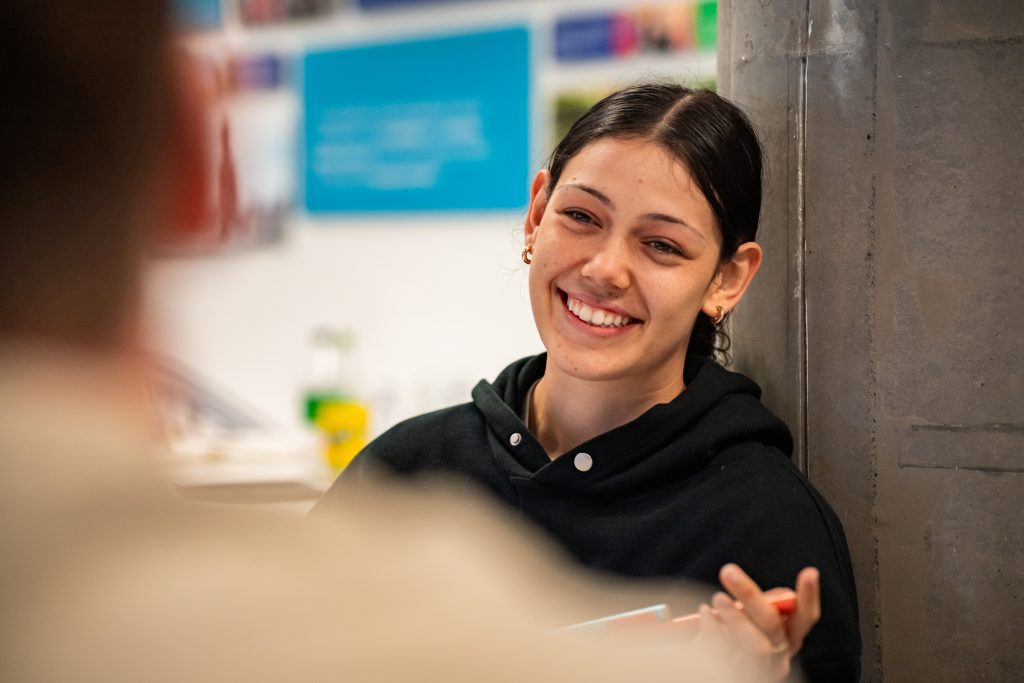
For many of those who took part in the pilot, it was a life-changing experience: “Before this, I didn’t feel like I was a part of the future, but now I definitely do…I really want to help make the change and just keep changing and be positive, because I think the future could be great.” It’s time we help more young people with the tools, confidence and relationships to become the masters of what comes next. Only then will we have a new generation leading the change – prioritising curiosity over reactivity, collaboration over polarisation, and future-making over future-taking.
Alice Dimond is an NGFP 2023 Fellow and works with Tokona te Raki, an Indigenous social innovation lab based in Aotearoa, New Zealand. Her work focuses on empowering rangatahi and communities to actively shape their futures. Her research as part of SOIF’s Futures Methods From Around the World project has helped inform the tools and resources designed for Mō Āpōpō.